
Artificial Intelligence is Changing the Way Creators Edit Photos and Videos
Artificial intelligence is transforming the process of photo and video editing by shifting the burden of manual work to automated processes. AI systems allow the use of fewer repeated steps, which means that now it’s possible to devote editing time to creative decision-making rather than to the technical side of work for those designers and artists who have to deal with a lot of content.
AI vs Traditional Approach in Editing
Editing can be a long process, and to understand that some procedures need to be done first before one can work on an image or a video. AI is capable of combining certain procedures by detecting people, objects, backgrounds, images, and scenes. This is crucial when the changes need to be applied to many files.
Based on the report by Data Intelo, the value of the international artificial intelligence market in 2025 was estimated at $214.6 billion, while it is expected to grow up to $3,680.5 billion in 2034 with a compound annual growth rate (CAGR) of 35.7% from 2026 to 2034 showing the growth of AI usage in automated work processes.
The estimated time saved could be 120 minutes if one uses automated masking on 60 pictures. The efficiency percentage is higher for 300.
Generative AI Expands Image Editing
Generative AI has transformed editing tasks from just error correction to various functions. It allows the systems to broaden images and to add elements, fill voids, change background etc instead of being only corrective.
A 2000 by 3000-pixel photo has 6 million pixels altogether. Increasing the size of the photo produces 24 million pixels because its size increases four times according to the product of dimensions of the new photo compared to its previous size.
This operation is helpful for older pictures and images with low resolution. But although detail produced is sharper, it still does not guarantee that the image would have been true to original even at the higher resolution level.
Automation Is on the Rise in Video Editing
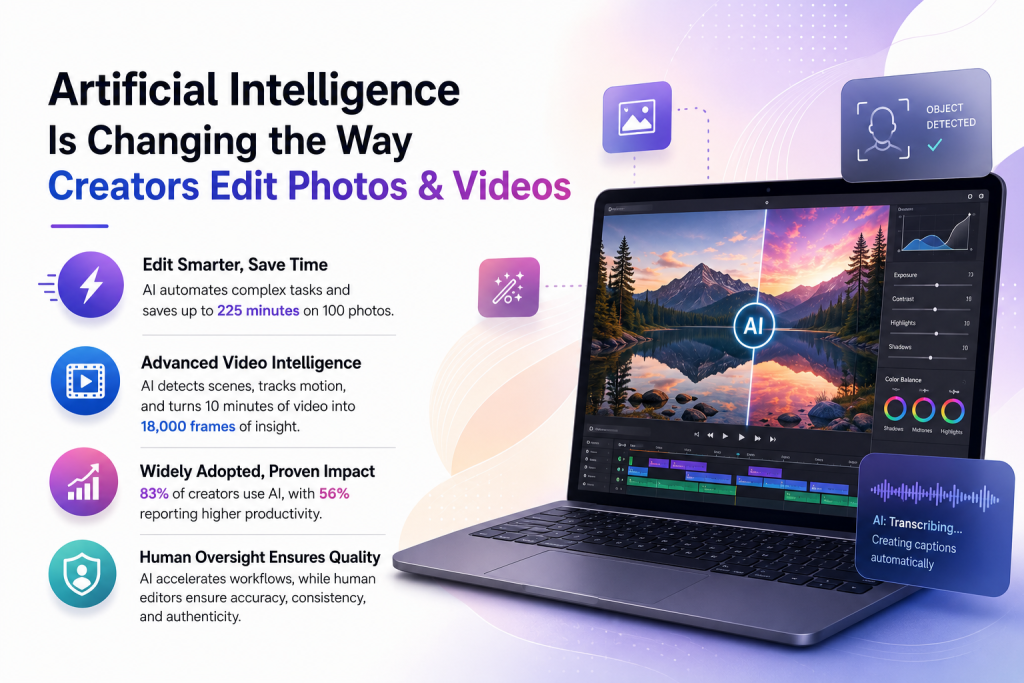
Video is much more computing-heavy as it consists of multiple pictures. For instance, a ten-minute video shot at 30 frames per second consists of 18,000 pictures.
AI software for video editing takes the images into consideration for sight changes detection, character movement tracking, speech recognition, subtitles creation, and the required segment retrieval. Speech recognition allows transforming a ten-minute video into searchable text.
This capability saves time needed for preparation of interviews, lessons, podcasts, and other short videos.
Use of AI in Creative Work is on the Rise
The use of AI has surged as editing technologies have improved. A recent study shows that AI is used by 83% of creators, with 56% experiencing a boost in productivity and 52% using it for editing purposes.
A survey in 2024 revealed that 75% of more than 4,000 business leaders and knowledge workers have used AI to help them with work.
This indicates that AI-assisted editing is going beyond experimentation, as the majority of respondents report the use of AI for productivity or editing purposes.
Where AI Offers Practical Advantages
AI generally provides the strongest efficiency gains when the same operation must be repeated across many files. Common applications include:
- Background removal and automatic subject isolation
- Object detection across large image libraries
- Automatic captions and speech transcription
- Audio noise reduction across multiple minutes of footage
- Batch color and exposure adjustments
- Subject tracking across moving video frames
To process 100 photographs which take 3 minutes to be done takes about 300 minutes. If you operate with an automation process that will allow you the time of about 45 seconds per image, you will take 75 minutes. Thus, there is a time saving of 225 minutes. Actual savings vary with complexity and human review.
Quality and Accuracy Still Require Human Oversight
Faster editing does not automatically produce better editing. AI systems can generate incorrect textures, altered facial details, inconsistent lighting, or unrealistic object boundaries. Video tools can also create temporal inconsistencies in which an object changes appearance between consecutive frames.
If you edit 500 properties and make a 2% error, it will approximately equal ten assets to be rechecked. If you make a 5% error, in that case, you’ll have twenty-five assets to be checked again.
There is a need for human supervision when it comes to editing work. Editors have to make sure that the changes created keep all the significant aspects intact and provide a solid and coherent text.
AI Editing Developments at a Glance
| Editing area | AI-assisted development | Numeric scale |
| Image masking | Automated subject isolation | 60 images × 2 minutes = 120 minutes |
| Image upscaling | AI-estimated detail | 2× dimensions = 4× pixel area |
| Video analysis | Scene detection | 10 minutes at 30 fps = 18,000 frames |
| Captioning | Speech-to-text | 10-minute video produces searchable dialogue |
| Batch editing | Automated corrections | 100 images × 3 minutes = 5 hours |
Synthetic Media Is Changing Authenticity Checks
Artificial intelligence (AI) editing has given rise to new challenges pertaining to the authenticity of visual material. Metadata, provenance details, digital credentials and watermarking technologies take on much greater significance with the growing ability to create and alter content.
A 20-second video that was filmed at the rate of 30 frames per second will total to an amount of 600 frames in place which means that while one small change in the video will cause problems that will not be simply detected.
The verification process no longer focuses solely on the visual detection of changes that have been made. With editing systems being capable of performing changes that are hard to trace through the eyes.
What Comes Next for Creators
Future AI-assisted editing is likely to coordinate image generation, video analysis, audio processing, and asset organization. Systems can increasingly analyze several elements within one integrated workflow.
A one-minute-long video that was captured at a rate of 30 frames per second would have roughly 1,800 frames that combine with audio, written captions, scene changes, and characters. Technologies capable of analyzing these aspects simultaneously will be able to free us from many labour-intensive pre-production tasks, although we will still remain in charge of the final product.
AI alters how creative work is being distributed. We now have increasingly automated repetitive procedures while human editors are still crucial for matters of making a judgement call, storytelling, maintaining accuracy and consistency, and making the final creative decisions.